
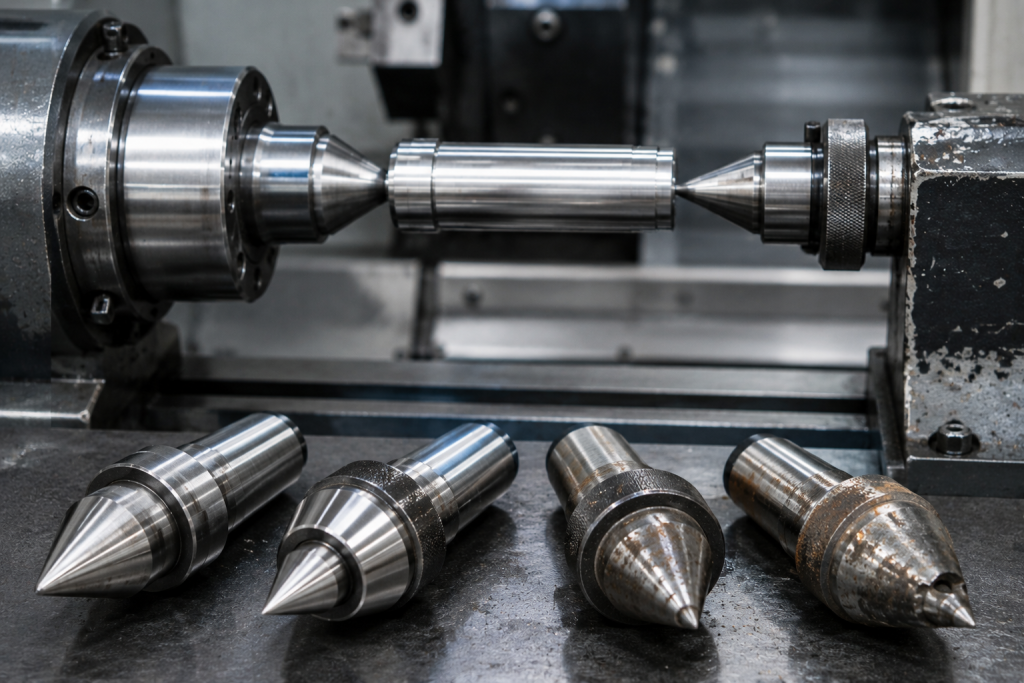
In precision engineering, tooling condition has a direct impact on machining quality. Even small amounts of wear in centres or supporting tooling can gradually introduce inaccuracies that affect tolerances, surface finish, and repeatability.
The problem is that wear often develops slowly, making it difficult to spot until production quality begins to suffer. For machine shops and manufacturers working to tight tolerances, recognising the warning signs early can prevent costly downtime and rejected components.
Why tooling wear matters
Every machining operation relies on accurate alignment and stability. Once centres or tooling begin to wear, the entire process becomes less consistent.
Common issues caused by worn centres include:
- Increased runout
- Poor concentricity
- Vibration during machining
- Reduced surface finish quality
- Inconsistent tolerances across batches
These problems often appear gradually, which is why they are sometimes overlooked until components begin failing inspection.
Common signs your centres may be worn
One of the first indicators is a decline in machining consistency.
You may notice:
- Components requiring additional finishing work
- More frequent quality control failures
- Visible marking or scoring on the workpiece
- Increased machine vibration or noise
Another common sign is reduced repeatability between production runs, particularly on precision-ground parts.
Ignoring these warning signs can increase production costs and reduce overall machining efficiency.
The impact on precision engineering
In high-accuracy machining environments, even microscopic variations matter.
A worn centre can introduce slight movement into the workpiece, which affects:
- Roundness
- Surface finish
- Dimensional accuracy
- Tool life
This becomes particularly important in industries where components must meet extremely tight tolerances.
Using precision-engineered centres with high roundness accuracy helps maintain consistency throughout the machining process.
Why carbide centres last longer
Material selection plays a major role in tooling longevity.
Standard steel centres can perform well in many applications, but over time they are more susceptible to wear and deformation.
Tungsten carbide centres provide several advantages:
- Greater dimensional stability
- Improved wear resistance
- Longer operational lifespan
- Better consistency under repeated use
For demanding machining environments, carbide-tipped centres offer a practical solution that combines durability with excellent accuracy.
The importance of inspection and quality control
Tooling should never be treated as a fit-and-forget component.
Regular inspection helps identify wear before it impacts production quality.
Professional engineering environments often inspect centres for:
- Roundness accuracy
- Surface condition
- Dimensional consistency
- Signs of chipping or deformation
Using calibrated inspection equipment ensures worn centres are identified early, helping maintain machining performance and reducing unnecessary downtime.
Best practices for maintaining machining accuracy
Keeping tooling in good condition improves both quality and productivity.
A few practical steps include:
- Inspect centres regularly during production runs
- Replace worn tooling before tolerances drift
- Use carbide solutions in high-wear applications
- Store centres correctly to avoid accidental damage
Investing in high-quality precision tooling often reduces costs long term by minimising scrap, downtime, and rework.
Conclusion
Worn centres and tooling can have a significant effect on machining accuracy, even before the wear becomes visibly obvious.
Maintaining tight tolerances requires more than quality machinery alone. Consistent inspection, proper material selection, and high-precision centres all play a critical role in achieving reliable machining results.
Using durable, precision-manufactured centres helps maintain production quality, improve repeatability, and reduce costly machining issues over time.