
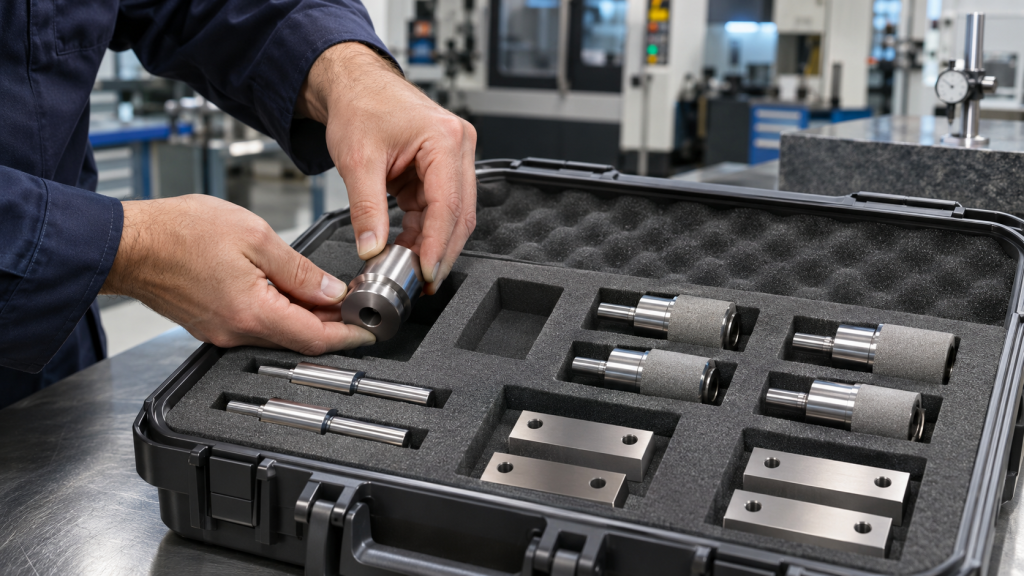
To protect tungsten carbide tooling between jobs, keep each component clean, supported and separated from other tools. Use suitable protective packaging, avoid knocks and inspect parts before returning them to service.
It is easy to focus on how tooling performs inside a machine and overlook what happens when it is removed. Yet a precision component can suffer damage on a bench, in a drawer or while being moved around the workshop.
For manufacturers investing in bespoke tooling, a consistent handling and storage routine helps protect that investment.
Why can hard carbide tooling still suffer damage?
Hardness and toughness are different properties. Cemented tungsten carbide offers excellent wear resistance, but it can chip or fracture under unsuitable impact or loading. A hard surface does not make a component immune to being dropped or knocked against another part. ceratizit.com
The practical lesson is straightforward: treat carbide tooling as precision equipment. Protect working surfaces, thin sections and edges, even when a component looks substantial.
How should you store tungsten carbide tooling?
Give each component its own protected position
Avoid placing loose tooling together in a drawer. Individual compartments, suitable sleeves or fitted cases help prevent contact between components. Support the body of the part rather than allowing a delicate tip or projection to carry its weight.
Retain suitable original packaging where practical. For bespoke parts, consider a dedicated storage position that matches the component’s shape and size.
Clean and dry parts before putting them away
Follow the cleaning method recommended for the component and its assembly. Remove contamination without scraping precision surfaces or using an abrasive method that could change their finish.
Do not assume that every cleaner is suitable for every carbide grade, coating or joint. If you are unsure, ask your tooling supplier before applying it.
Keep storage organised
Identify components by part number and drawing revision where applicable. Keep serviceable tooling separate from items awaiting inspection, repair or replacement.
A clearly identified storage position also makes it easier to spot a missing spare before the next production run.
What should you check before refitting a tool?
Before installation, check the component for visible chips, cracks, damaged threads and contamination on locating surfaces. Inspect the mating surfaces and holder as well as the tool itself.
A visual check is a useful first step, but it does not confirm dimensional accuracy or reveal every defect. Where the application requires it, carry out the relevant dimensional or runout checks using suitable inspection equipment.
If a component has been dropped or shows possible damage, set it aside for assessment rather than returning it straight to production.
Which handling mistakes should you avoid?
Common mistakes include:
- Leaving cylindrical tooling free to roll across a bench.
- Stacking components together without protection.
- Transporting precision parts loose in a toolbox.
- Forcing a component into a dirty or unsuitable mounting.
- Returning suspect tooling to the same drawer as inspected parts.
Use a suitable tray or case when moving tooling between workstations. During installation, follow the equipment and tooling instructions rather than using extra force to overcome a fit problem.
Can damaged carbide tooling be repaired?
Sometimes specialist assessment may identify a suitable regrinding or repair option. However, that depends on the damage, remaining material and finished dimensions required. Do not assume that a chipped component can simply be ground back and reused. hardmaterials.ceratizit.com
When requesting advice, provide the drawing, photographs of the damage and details of what happened. These help establish whether assessment, replacement or a change to the application is the appropriate next step.
Make tooling care part of your workshop routine
A practical routine does not need to be complicated: clean the part appropriately, inspect it, protect it and return it to an identified storage position. Applying the same process after every job helps prevent avoidable handling damage.
At Trio Tools, we manufacture bespoke tungsten carbide tooling and precision components to customers’ drawings, including grinding quills, centres and wear parts. Explore our precision tooling and wear components to learn more. Trio Tools
If you need a replacement component or want to discuss a tooling requirement, contact Trio Tools on 01277 814580.
Frequently asked questions
Can tungsten carbide tooling chip if dropped?
Yes. Despite its hardness and wear resistance, carbide can chip or fracture under impact. A dropped component should be assessed before reuse.
Should carbide tools be stored together in a drawer?
Avoid loose contact between components. Separate compartments or suitable protective packaging help protect precision surfaces and edges.
Does an undamaged appearance mean a tool is ready to use?
Not necessarily. Visual inspection does not establish dimensional accuracy. Complete the checks required for the component and application before use.