
Internal grinding is often used when a component requires an accurate bore, a fine surface finish or a particularly tight dimensional tolerance. However, achieving consistent results can become difficult when the grinding wheel must reach deep inside a narrow component.
The grinding quill might appear to be a relatively simple part of the machine setup, but its design and condition can have a significant effect on machining accuracy. Excessive runout, insufficient rigidity or the wrong quill material can lead to vibration, inconsistent bore sizes, poor surface finishes and premature wheel wear.
Choosing the right internal grinding quill can therefore make a measurable difference to productivity, component quality and overall manufacturing costs.
What Is an Internal Grinding Quill?
An internal grinding quill, sometimes called a grinding spindle quill or wheel quill, connects the grinding spindle to the abrasive wheel used to machine an internal diameter.
Because the wheel must fit inside the component, the quill is normally long and relatively narrow. This makes it more susceptible to deflection and vibration than many other types of machine tooling.
Grinding quills may be manufactured for:
- Glued or bonded grinding wheels
- Screwed-in grinding wheels
- Different spindle and thread arrangements
- Shallow or deep-bore grinding
- High-speed precision grinding applications
- Bespoke machines and specialist components
The exact dimensions, material and connection method must be matched to the machine, grinding wheel and component being produced.
Why Grinding Quill Rigidity Is Important
During grinding, forces are applied to the wheel and transferred through the quill. If the quill is insufficiently rigid, it may deflect slightly under load.
Even a very small amount of movement can affect the finished component, particularly where extremely tight tolerances are required.
Insufficient rigidity can contribute to:
- Tapered or uneven bores
- Variation between components
- Chatter marks
- Poor roundness
- Inconsistent surface finish
- Longer cycle times
- Increased wheel wear
- More frequent dressing requirements
A machine operator may attempt to compensate by reducing the depth of cut or slowing the process. Although this can sometimes improve the immediate result, it also reduces productivity and does not address the underlying weakness in the tooling setup.
A properly designed quill provides the stiffness needed to support the wheel while remaining slim enough to access the required internal diameter.
How Runout Affects Grinding Accuracy
Runout occurs when the grinding wheel does not rotate perfectly around its intended centreline. Instead, the wheel moves slightly from side to side as it turns.
In internal grinding, even minimal runout can be enough to affect bore size, roundness and surface quality.
Common symptoms can include:
- An uneven grinding pattern
- Difficulty maintaining bore tolerances
- Excessive vibration or noise
- Localised wheel wear
- Poor component roundness
- Frequent process adjustments
- Good and bad parts appearing within the same production run
Runout may originate from the spindle, wheel mounting, contamination between mating surfaces or damage to the quill. It can also result from a quill that has not been manufactured accurately enough for the application.
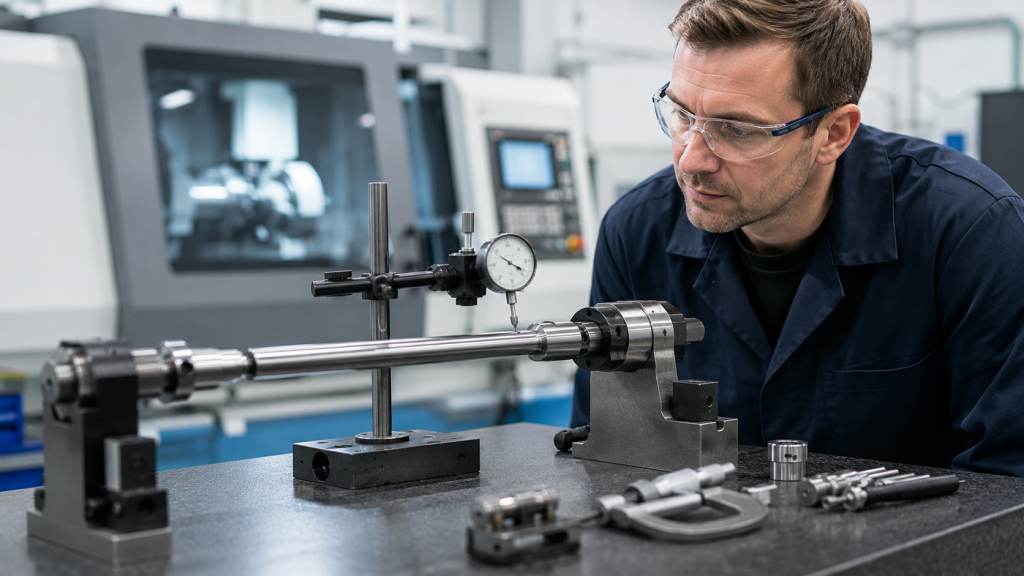
This is why dimensional inspection alone is not always sufficient. A precision grinding quill should also be checked in a representative machine head or inspection setup to confirm that it runs accurately when mounted.
Tungsten Carbide or Steel Grinding Quills?
The material used to manufacture a grinding quill influences its stiffness, durability, weight and suitability for a particular application.
Tungsten carbide grinding quills
Tungsten carbide provides excellent rigidity and dimensional stability. It is particularly suitable for longer or narrower quills where resistance to deflection is essential.
Potential advantages include:
- Greater rigidity than conventional steel
- Reduced deflection on long overhangs
- Improved vibration resistance
- Better dimensional stability
- Support for consistent surface finishes
- Longer working life in demanding applications
Carbide quills can be particularly valuable when grinding deep bores or when the wheel diameter leaves very little room for a larger tool section.
Heavy tungsten alloy grinding quills
Heavy tungsten alloy can provide a useful balance of mass, rigidity and vibration damping. Depending on the machine and grinding application, it may help create a more stable grinding arrangement.
Tool steel grinding quills
Tool steel remains suitable for many shorter, less demanding or larger-diameter applications. It may also represent a more economical choice where the quill dimensions already provide sufficient rigidity.
The most expensive material is not automatically the correct choice. The quill should be designed around the overhang, wheel size, operating speed, component material and required tolerances.
The Importance of Quill Length and Overhang
As a general principle, increasing the unsupported length of a grinding quill increases its susceptibility to deflection.
A longer quill may be necessary to reach the bottom of a deep component, but unnecessary length should be avoided. The design objective is normally to use the shortest practical overhang while maintaining safe access to the complete grinding area.
When a long reach cannot be avoided, material choice and quill diameter become especially important.
An experienced tooling manufacturer can review the application and recommend a design that provides the necessary access without sacrificing more rigidity than required.
Glued Wheels and Screwed-In Wheels
Internal grinding quills can be manufactured to accept different types of grinding wheel.
Glued or bonded wheels are secured directly to a prepared section of the quill. This can create a compact assembly suitable for small internal diameters.
Screwed-in wheels use a threaded connection. The thread must be manufactured accurately to ensure secure mounting and correct wheel alignment.
The most suitable arrangement will depend on factors including:
- Wheel diameter
- Operating speed
- Bore dimensions
- Machine specification
- Replacement frequency
- Accessibility
- The grinding wheel manufacturer’s requirements
Where particularly small threaded connections are required, specialist manufacturing methods such as spark erosion may be needed to produce accurate threads in carbide.
Signs That a Grinding Quill May Need Replacing
Grinding problems are sometimes blamed immediately on the wheel, machine or operator. The quill should also be included in the investigation.
Possible signs of a worn, damaged or unsuitable quill include:
- Runout that returns after fitting a new wheel
- Previously stable dimensions beginning to vary
- Increasing levels of chatter
- Unexplained deterioration in surface finish
- Visible damage to mounting surfaces or threads
- Corrosion or fretting around the connection
- A quill that has been repeatedly modified
- Difficulty achieving the required result without reducing production speed
The quill and its mounting surfaces should be cleaned and inspected before replacement is considered. If problems remain, dimensional and runout checks can help identify whether the tooling is contributing to the fault.
Why Bespoke Grinding Quills Can Improve Production
Standard tooling is useful when it matches the application, but compromises may arise when it is too long, insufficiently rigid or poorly suited to the chosen wheel.
A bespoke internal grinding quill can be manufactured around the actual production requirements, including:
- The required reach and working clearance
- Spindle connection details
- Grinding wheel mounting
- Maximum practical quill diameter
- Operating speed
- Component geometry
- Material being ground
- Required tolerances and surface finish
This allows the complete setup to be considered rather than treating the quill as an interchangeable accessory.
A well-designed bespoke quill may help reduce setup adjustments, improve repeatability and allow the grinding process to operate closer to its intended speed.
Information Needed When Requesting a Quotation
Supplying accurate information at the quotation stage helps the tooling manufacturer recommend the right material and design.
Where possible, provide:
- A detailed engineering drawing
- Overall quill length
- Maximum permitted diameter
- Spindle connection dimensions
- Thread specification
- Grinding wheel dimensions
- Operating speed
- Required runout or concentricity
- Component bore depth
- Material being ground
- Details of any existing performance problem
If an existing quill is available, it may also be possible to manufacture a replacement from a sample, subject to inspection and confirmation of the critical dimensions.
Bespoke Internal Grinding Quills from Trio Tools
Trio Tools manufactures precision internal grinding quills for demanding engineering applications. Quills can be produced in high-quality tungsten carbide or heavy tungsten alloy and tailored to suit glued-on or screwed-in grinding wheels.
Every quill is checked for dimensional accuracy and inspected for runout, helping customers maintain the consistency required in precision internal grinding.
Whether you need a replacement for an existing quill, a more rigid solution for a difficult deep-bore application or bespoke tooling for a new production process, speak to Trio Tools about your requirements.
Contact Trio Tools on 01277 814580 or send your drawing and application details to sales@trio-tools.com for a quotation.