
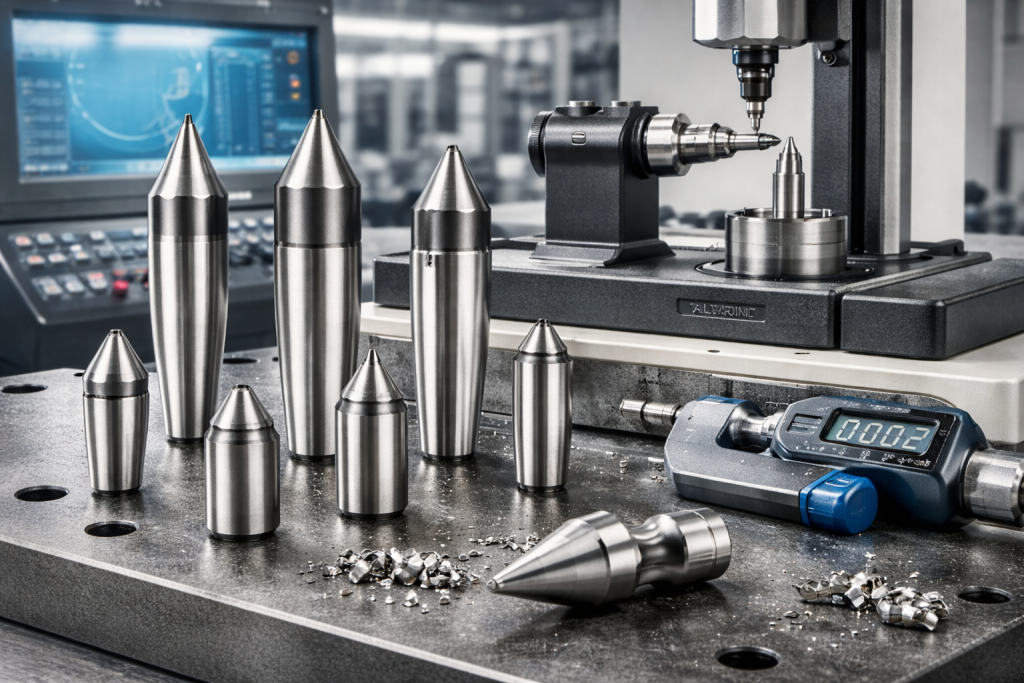
In precision engineering, even the smallest variation can cause major issues. When components need to run true, consistently and at high speed, the quality of the centre you’re using becomes critical.
Precision grinding centres are a core part of many machining operations, particularly where accuracy, repeatability, and surface finish matter. For engineers, machinists, and manufacturers, choosing the right centre isn’t optional, it directly affects performance, tolerance, and longevity.
The role of precision grinding centres
Grinding centres are used to support and align workpieces during machining processes such as grinding, turning, and inspection.
Their job is simple in theory, hold the component perfectly central. In practice, this requires extremely tight tolerances.
If the centre is even slightly out, it can lead to:
- Poor surface finish
- Inconsistent tolerances
- Vibration during machining
- Increased wear on machinery and tooling
This is why high-quality centres, manufactured to exact specifications, are essential in any professional workshop.
What sets precision centres apart
Not all centres are created equal. Precision grinding centres are manufactured to extremely tight tolerances, often achieving roundness values as low as 0.0002mm.
This level of accuracy ensures:
- Smooth rotation of components
- Reduced runout
- Improved machining consistency
- Better final product quality
Precision centres can be produced in a range of sizes, typically from No 1 MT to No 6 MT, and are available as:
- Male or female centres
- Whole or half centres depending on application
This flexibility allows them to be tailored to specific machining requirements.
Materials and why they matter
Material choice plays a major role in performance.
While standard materials are suitable for general use, tungsten carbide is widely recommended for precision centres due to its dimensional stability and resistance to wear.
Benefits of carbide centres include:
- Longer service life
- Greater resistance to deformation
- Consistent accuracy over time
- Reduced need for replacement
For more demanding applications, carbide-tipped centres offer an ideal balance between durability and cost efficiency, delivering high performance without requiring a fully solid carbide solution.
Manufacturing quality and inspection
Precision centres are only as good as the process used to make them.
Using high-end Swiss and German machinery ensures consistent manufacturing standards, tight tolerances, and reliable repeatability across batches.
However, production is only one part of the equation. Inspection is equally important.
Every centre should be:
- 100% inspected for roundness using specialist equipment such as a Talyrond roundness measuring machine
- Dimensionally checked using calibrated inspection tools
This level of quality control guarantees that each centre performs as expected straight out of the box.
Common mistakes when selecting centres
Choosing the wrong centre can undermine an otherwise well-executed job.
Common issues include:
- Selecting standard centres for high-precision work
- Ignoring material choice, particularly in high-wear environments
- Using worn centres beyond their effective tolerance
- Not matching the centre type to the application
These mistakes often result in rework, increased costs, and reduced machining efficiency.
Practical considerations for workshops
For engineering businesses and machine shops, consistency is key.
A few practical points:
- Standardise on high-quality centres across your workshop
- Replace centres before accuracy begins to drop
- Use carbide options where repeatability and longevity are critical
- Ensure compatibility with your machinery and application
Investing in reliable, precision-engineered centres reduces downtime and improves output quality across the board.
Conclusion
Precision grinding centres play a crucial role in achieving accurate, repeatable machining results. With tolerances down to 0.0002mm, the difference between a standard centre and a precision-engineered one is significant.
Material choice, manufacturing quality, and proper inspection all contribute to performance. When these elements are right, you get smoother operation, better finishes, and more consistent results.
Choosing the right centres ensures your machining processes remain efficient, accurate, and dependable, job after job.